
They’re ‘Just Playing’ — Here’s What Your Child Is Actually Learning
A four-year-old dressed in a cape “flying” around the backyard. Two three-year-olds negotiating the rules of an elaborate tea party. A toddler who has spent 20 minutes stacking and knocking down the same tower of blocks. To an adult eye, this might look like nothing — just play, just killing time, just being a kid.
But developmental researchers, educators, and neuroscientists will tell you something different: play is the most powerful learning tool humans have, and early childhood is its prime season.
At Brainy Kids Place, play isn’t what we do when the “real” learning is done. Play is the curriculum. Here’s why — and what your child is actually learning when they play.
What the Science Says About Play
The National Academy of Sciences, the AAP, and decades of child development research converge on a clear conclusion: play is not a break from learning. It is the primary vehicle through which young children learn.
During play, children’s brains are highly active. They’re processing information, testing hypotheses, developing language, building social skills, managing emotions, and constructing their understanding of how the world works — all simultaneously. Play activates more brain regions simultaneously than almost any other activity in early childhood.
Perhaps most importantly, play is self-directed. Children choose what to engage with, how long to stay with it, and what problems to solve. This autonomy builds intrinsic motivation — the love of learning — that research consistently shows is one of the strongest predictors of academic success.
Types of Play and What They Develop
Solitary Play (Playing Alone)
A toddler building alone in the block corner is not isolated — they’re deeply engaged. Solitary play develops focus and concentration, creativity, problem-solving, and the capacity for independent thought. Children who can play happily alone are developing something essential: the ability to generate their own ideas and see them through.
Parallel Play (Playing Alongside)
Two children playing with similar materials side-by-side without much direct interaction might look like they’re ignoring each other — but parallel play is actually a critical developmental stage. Children are watching, learning social norms by observation, and beginning to regulate their behavior in the presence of others. It’s the on-ramp to collaborative play.
Cooperative Play (Playing Together)
When children play together toward a shared goal — building a fort, playing house, creating a game — they’re doing something extraordinarily complex. They’re negotiating, communicating, managing conflict, sharing resources, and taking perspectives different from their own. The skills required for cooperative play are the same skills that make someone effective in a workplace, a marriage, and a democratic society. They start at the block table.
Dramatic/Pretend Play (Imaginary Play)
Dramatic play is often where parents dismiss the educational value most readily — but pretend play may be the most cognitively demanding thing preschoolers do. When a child plays “house” or “doctor,” they are:
- Developing language — narrating, dialoguing, inventing stories
- Building theory of mind — understanding that other people have different perspectives, feelings, and knowledge
- Processing real experiences — playing out things that happened (a doctor visit, a parent leaving for work) to make sense of them
- Practicing emotional regulation — embodying characters allows safe exploration of strong feelings
- Building early literacy — the story structure of pretend play directly supports comprehension of narrative text later
Constructive Play (Building and Making)
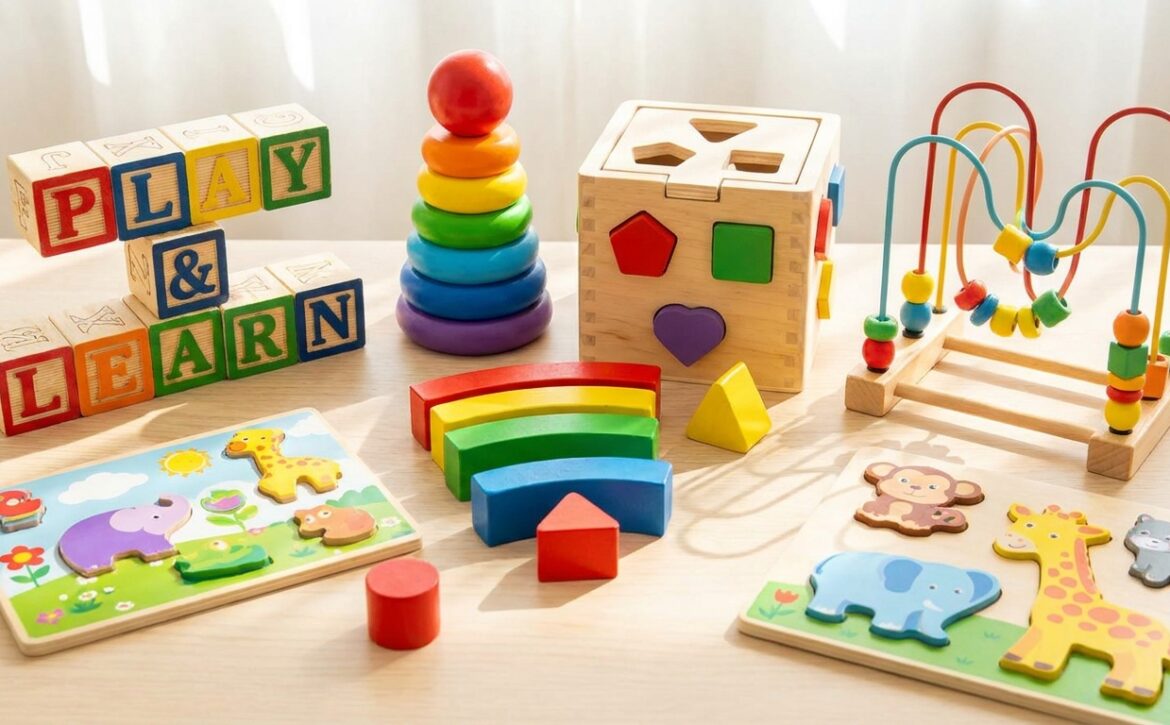
Blocks, Legos, sand, clay, paint, puzzles — constructive play is the place where spatial reasoning, math concepts, engineering thinking, and aesthetic sensibility develop. When a child figures out that the tower keeps falling because the wide side needs to be on the bottom, they’ve just done physics. When they represent a house or a rocket ship with blocks, they’re drawing on symbolic reasoning that underlies all abstract thought.
Active/Physical Play (Moving and Doing)
Running, climbing, jumping, wrestling, dancing — physical play isn’t just good for bodies. It’s essential for brain development. Proprioception (knowing where your body is in space), vestibular development (balance and movement), and cross-body movement all support neurological integration that underlies reading and writing. The child who struggles to sit still may actually need more movement, not less.
How Parents Can Support Learning Through Play at Home
The best thing parents can do for play is create the conditions for it — not direct it or over-structure it.
- Offer open-ended materials. Blocks, art supplies, sand, water, fabric, cardboard boxes — materials that have no predetermined use spark more creativity and learning than electronic toys with one correct answer.
- Protect unstructured time. Children don’t need every hour scheduled. Boredom is a gateway to creativity; a child who says “I’m bored” is one good open-ended material away from an hour of engaged play.
- Follow their lead. When you play with your child, let them direct. Ask questions (“What happens if we try…?” “What does this character want?”) rather than guiding the plot.
- Don’t rescue too fast. When children are problem-solving through play and hit a challenge, wait before stepping in. The struggle is the learning.
- Narrate what you notice. “You’re working really hard on that tower” or “You and your friend figured out how to share the truck” helps children articulate what they’re learning and builds metacognitive awareness.
- Play alongside them. Reading on the floor while they play, or occasionally joining the pretend world they’ve created, signals that what they’re doing is valuable. You don’t need to make it educational — your presence is enough.
Why Play-Based Curricula Work
There’s a persistent cultural myth that children learn more in classrooms that look more like schools — with worksheets, rote practice, and academic drilling — than in play-based environments. Research says the opposite.
Long-term studies of play-based preschool graduates consistently show better outcomes in academic achievement, social competence, creativity, and emotional health than children who attended academically-focused preschools — especially by middle and high school, when executive function and motivation become the dominant factors in success.
Pushing formal academic skills too early doesn’t accelerate development — it can actually interrupt it by replacing the play experiences children need to build the cognitive foundations that formal learning rests on.
How BKP Approaches Play-Based Learning
At Brainy Kids Place, our curriculum is grounded in Frog Street — a research-based, play-centered curriculum that develops the whole child across all developmental domains. Our teachers are trained to observe, scaffold, and enrich children’s play rather than replace it with direct instruction.
What this looks like in practice: learning centers stocked with materials that invite exploration, outdoor environments designed for active and constructive play, dramatic play areas that change with our learning themes, and teachers who know how to extend a child’s thinking with a well-timed question rather than a pre-made worksheet.
We know the value of what your child does all day — and we document it so you can see it too.
Want to see play-based learning in action? Schedule a tour at Brainy Kids Place and watch our classrooms at work.